
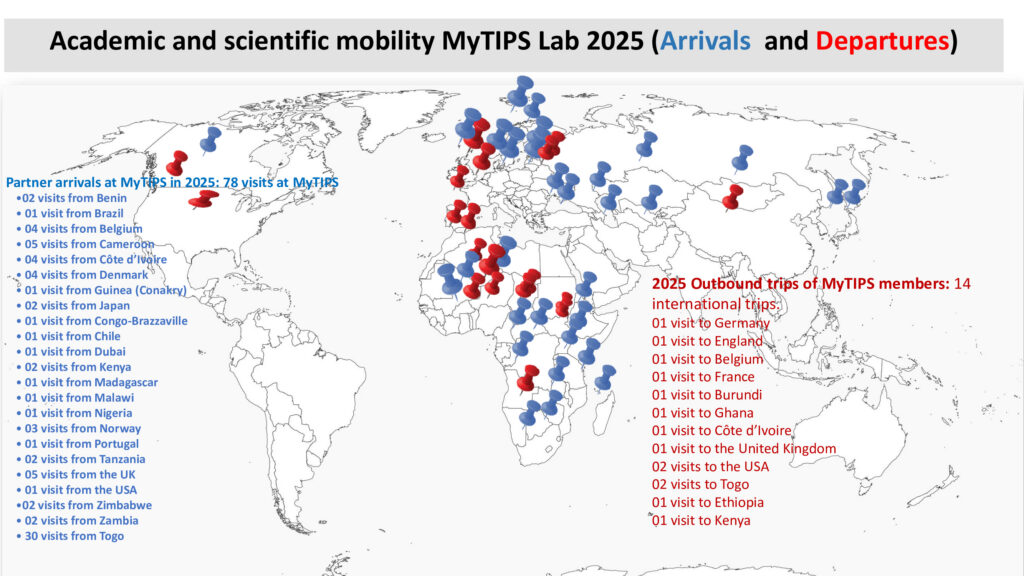
In 2025, MyTIPS Lab demonstrated strong academic and scientific dynamism through extensive inbound and outbound mobility. A total of 78 partner arrivals strengthened collaboration, knowledge exchange, and joint research activities focused on fungal diversity, taxonomy, and conservation strategies. In parallel, MyTIPS members undertook 14 international outbound trips across Europe, Africa, and North America, fostering partnerships on sustainable use, monitoring, and preservation of fungal resources. These mobilities enhanced capacity building, technology transfer, and the harmonization of conservation approaches. Overall, academic mobility in 2025 significantly contributed to advancing fungal conservation efforts, reinforcing MyTIPS’ leadership in mycology and biodiversity conservation at regional and global levels

On the morning of November 10, 2025, a delegation from the 4th Congress of the International Society for Fungal Conservation (ISFC4) visited MyTIPS at the University of Parakou, Benin. The visit provided an opportunity for delegates to explore the laboratory’s innovative research in fungal conservation and sustainable use. During their visit, they engaged with researchers to exchange ideas on how scientific knowledge can enhance community livelihoods and biodiversity conservation. The delegation also held a productive meeting with the Vice-Rector. Later, the group traveled to Papatia to meet with beneficiaries of the FC-SSA project and observe ongoing field activities. This visit highlights the strong connection between research, education, and local action, and underscores the role of scientific collaboration in advancing sustainable conservation.

The 4th International Congress of the International Society for Fungal Conservation (ISFC4) was successfully held from November 3 to 7, 2025, in Cotonou, Benin marking a historic first in Africa! The event brought together over 80 participants from more than 30 countries researchers, students, IUCN experts, and biodiversity actors all united under the theme: “Mainstreaming Fungal Conservation” Integrating fungal conservation into global biodiversity policies. For five days, the congress featured inspiring conferences, panel discussions, and workshops addressing the crucial role of fungi the often-forgotten heroes of our ecosystems and the need to include them in conservation priorities. In this national TV report, listen to the reactions of Professor Nourou Soulemane Yorou, President of the Organizing Committee, and Professor Brice Sinsin, who both highlight the scientific and symbolic significance of this milestone event for Africa. A big congratulations to the organizing team, partners, and participants for this remarkable success that proudly places Benin on the global map of fungal conservation. 🎬 Watch the video below to relive the key moments and reflections from ISFC4! https://drive.google.com/file/d/1TM44oMyEmGrFmHysFng-3GH6a3UdYqeo/view?usp=sharing #ISFC4 #FungalConservation #FungiMatter #ScienceForNature #Benin #Africa
Fungal Resources for Human Well-being: Implications for Poverty and Gender Inequality in Sub-Saharan Africa Our new article presents the first large-scale synthesis on the role of wild useful fungi (WUF) in Sub-Saharan Africa. From 95 scientific papers, we identified 396 fungal species, including 47 with medicinal uses. These fungi are rich in proteins, vitamins, and minerals, contributing significantly to nutrition, food security, and traditional healthcare. Economically, WUF harvesting and trade mostly led by rural women provide essential income that supports families’ food, education, and health needs. However, challenges like deforestation, under-documentation, and gender inequality threaten their sustainable use. The study calls for inclusive policies, cultivation programs, and value chain strengthening to unlock fungi’s full potential for sustainable development. Read more: https://urlr.me/Pn8Mrx

Abdoul-Azize Boukary has successfully completed and defended his PhD thesis at the University of Parakou under the supervision of Prof. Dr. Ir. Nourou Souleman YOROU. His research, titled “Production and culture of edible mushrooms in Benin: Towards the valorization of local saprotrophic species,” provides innovative solutions to the seasonal scarcity of mushrooms in West Africa. By promoting the off-season cultivation of local edible fungi, his work fills a critical gap and contributes to food security, poverty reduction, and the sustainable use of biodiversity. We are proud of this milestone achieved at MyTIPS, and celebrate this success for science, agriculture, and local livelihoods! Congratulations, Dr. Boukary! @MyTIPS @FC-SSA @UniversitéDeParakou

We are proud to announce the successful defense of Dr. Olyvia Gwladys FADEYI, whose research focused on: “Ethnomycological investigations, food and medicinal potential of wild mushrooms in Benin.” Conducted under the supervision of Prof. Dr. Ir. Nourou SOULEMANE YOROU at the Doctoral School of Agronomic and Water Sciences, University of Parakou, this work strengthens the core of excellence at MYTIPS the Research Unit on Tropical Mycology and Plant-Soil Fungi Interactions. Beyond the scientific impact, this milestone embodies MYTIPS’s commitment to gender-sensitive approaches by reinforcing women’s representation in fungal research and sustainable development.
To celebrate Benin’s National Tree Day, the FCSSA project planted 1,200 Afzelia seedlings in four beneficiary forests. This initiative was conducted in close partnership with local communities, forestry and wildlife officers, and project members. The project plays a crucial role in protecting biodiversity and conserving the habitats of wild fungi, which are vital for ecosystem health and local livelihoods. Through reforestation and community collaboration, FCSSA strengthens forest resilience and promotes sustainable management of natural resources, contributing to long-term environmental and socio-economic benefits. #biodiversity#forest Conservation #FungiHabitat#Reforestation#sustainability#Benin #FCSSA#communitymanager

From March 10 to 12, 2025, the Research Unit of Tropical Mycology and Plant-Soil Fungi Interaction participated in the International Conference on SDGs Kara 2025, emphasizing the crucial role of fungi in sustainable development. Their presentations covered fungal conservation and its contribution to SDG 15, the potential of mushroom cultivation in tropical Africa for food security and sustainability, and the impact of fungal resources on human well-being, poverty alleviation, and gender equality. The discussions highlighted the importance of fungi in biodiversity conservation, sustainable agriculture, and socio-economic empowerment. By showcasing these contributions, the team reinforced the relevance of fungi in addressing global challenges and advancing the Sustainable Development Goals.

Wilfrid, a member of the Fungal Conservation in Sub-Saharan Africa (FC-SSA) Project, recently participated in the 16th Conference of Parties (COP16) held in Riyad, Saudi Arabia. During a side event organized by CGIAR, Wilfrid delivered a compelling presentation on “What are some practical ways to ensure marginalized communities have a genuine voice in the planning and decision-making of restoration projects?” Drawing on insights from the FC-SSA project, Wilfrid highlighted how the initiative successfully combines biodiversity conservation with social empowerment. The project promotes community-driven approaches, including the establishment of local nurseries and the active involvement of women and marginalized groups in training and decision-making processes. By addressing gender inequality and poverty, the project serves as a model for inclusive and sustainable restoration efforts. The presentation resonated deeply with participants, who were fascinated by the tangible outcomes of the FC-SSA project. Notably, the project has strengthened gender equity while fostering biodiversity conservation a win-win for both people and the planet.